blog
How to Start Calisthenics for Beginners
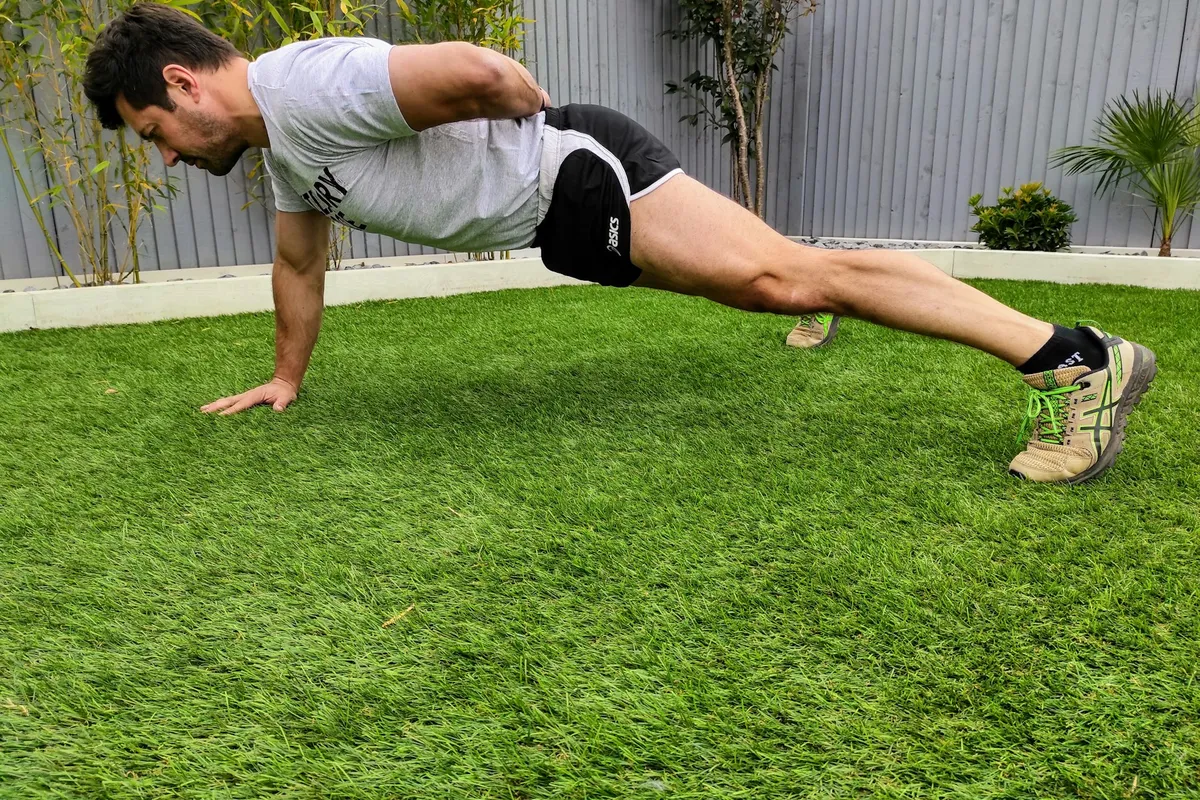
Start with 3 movements and their easiest versions: a dead hang or assisted pull, an incline push, and a bench dip. Train them 2 or 3 times a week, track 1 number per movement, and let a small first goal tell you when to move on.
 Say where you stand. RepMaxxing sets the target. coming soon
 What should you train first?
You should train 3 movements first: a pull, a push and a dip, each in the easiest version your body can currently do with full range and control. None of the 3 needs to start in its full form.
- The pull. Starts as a dead hang, then scapular pulls, then rows and negatives, worked up through the rungs in how to do your first pull-up.
- The push. Starts at a wall or on an incline, hands raised on a table or a counter, and moves toward the floor as described in how to do push-ups for beginners.
- The dip. Starts on a bench, feet on the floor, arms carrying only part of your weight, and moves to parallel bars later. Both versions are in dips for beginners.
Train the version you can do properly today, and let the exercise’s proper name catch up later.
Why these 3 movements?
These 3 movements cover pulling, pushing and a second pushing pattern that leans harder on the triceps, and between them they work most of the upper body. Youdas et al. (2010) measured the lats at 117 to 130 percent of a maximal isometric contraction during a pull-up, with the biceps at 78 to 96 percent. In a separate study the same year, Youdas et al. recorded the chest at 95 to 105 percent and the triceps at 73 to 109 percent during a push-up. McKenzie et al. (2022) compared bench, bar and ring dips in 13 men and found the bench dip mainly targets the triceps, with peak activation rising from 0.83 millivolts on the bench to 1.04 on the bar, which makes the bar dip the natural progression from the bench.
| Movement | Easiest version | Main muscles | Evidence |
|---|---|---|---|
| Pull | Dead hang, scapular pull, band assisted pull-up | Lats, biceps, lower trapezius | Youdas et al. 2010 (pull-up) |
| Push | Wall push-up, incline push-up, knee push-up | Chest, triceps, serratus anterior | Youdas et al. 2010 (push-up) |
| Dip | Bench dip with feet on the floor | Triceps, chest, front shoulder | McKenzie et al. 2022 |
The spread also keeps you balanced. Pulling and pushing muscles work in pairs, and a beginner who only ever pushes builds a tight front and a weak upper back long before the reps plateau. Training all 3 from the start, even at the easiest version, keeps the beginner phase even.
How often should you train?
You should train 2 or 3 times a week, with a rest day between sessions. The American College of Sports Medicine position stand on progression recommends 2 to 3 days a week for novices, with loads that allow 8 to 12 repetitions. Grgic et al. (2018) pooled 22 studies and found strength gains rose with frequency, from an effect size of 0.74 at 1 session a week to 0.93 at 3, and the gain was significant for the upper body in particular. The same analysis found no frequency effect once weekly volume was equated: what the extra days buy is more total work with rest between.
Daily maximum attempts mostly teach you to grind through bad reps under fatigue, which is a different skill from the one you are building. Robinson et al. (2024) ran meta-regressions on how close to failure sets are taken and found a negligible relationship with strength gains. Stop 2 or 3 reps short of failure in training, as a rule of thumb, and go all out only on a test day.
Does calisthenics build real strength?
Calisthenics builds real strength when the version keeps getting harder, and there is a direct test of that. Kotarsky et al. (2018) randomised 23 men to 4 weeks of either progressive push-up variations or barbell bench press, 3 days a week. Both groups raised their bench press 1 repetition maximum significantly, and the push-up group improved more on the push-up progression itself. Body weight is a load like any other. The condition is the word progressive: a wall push-up that stays a wall push-up for 3 months builds nothing after the first 2 weeks.
That is why each of the 3 movements has a series of versions. The version is the load, and you raise the load by changing the version, not by adding a plate.
What does a first goal look like?
A first goal is small enough to reach in a matter of weeks and specific enough to test on demand. If you cannot do a pull-up, a first goal might be a 20 second dead hang or 5 scapular pulls, not a bodyweight pull-up itself. If you can already manage a few push-ups, a first goal might be 10 clean ones; the reasoning behind that number is in how many push-ups a beginner should aim for. The exact number is a rule of thumb. The property matters: reachable soon, testable whenever you decide to try, with a yes or no answer.
Write the number down and retest it every 2 or 3 weeks, not every day. Between tests, train below that maximum.
What equipment do you need?
You need a bar, and everything else is optional. A gym rack or an outdoor fitness park covers the pull and, with parallel bars, the dip as well. The early pushing and dipping steps work on a wall, a table or a bench wherever you happen to be, which is why the first weeks are easy to fit in, but the bar is where every goal in this article is tested. The one purchase worth considering early is a resistance band, which turns a bar into a full pull-up you can practise; which thickness to buy is in resistance bands for pull-ups.
How do you turn 3 movements into a week?
You turn 3 movements into a week by putting all 3 on each of 3 training days, with sets sized from your own numbers, and that arrangement, which days, how many sets, how much rest, is the whole subject of the beginner calisthenics workout plan.
I built RepMaxxing to start every beginner the same way this article does. You enter your current numbers for pull-up, push-up and dip, 0 included, and the first goal workout, Foundation, is 6 sessions ending in 1 attempt at a target computed from those numbers and held fixed until you reach it. Weekly bodyweight workouts run Monday to Friday; filming a set is optional; Foundation is free.
Questions people actually ask
Do I need a gym to start calisthenics?
You need a bar you trust with your whole body weight, and the reliable ones are in a gym or an outdoor fitness park. The pushing and dipping steps can start on furniture, but the pull decides the question, and so does every goal worth testing.
How often should a beginner train calisthenics?
2 or 3 sessions a week, with a rest day between them. The American College of Sports Medicine's position stand recommends 2 to 3 days a week for novices, and Grgic et al. (2018) found strength gains rise from 1 to 3 sessions a week and then flatten.
What should my first calisthenics goal be?
Something small and testable, not the finished exercise. If a full pull-up is out of reach, a first goal might be a 20 second dead hang or 5 scapular pulls. If you already do a few push-ups, 10 clean ones is a fair first target. Those numbers are a rule of thumb; the property that matters is that you can test them next week.
Can I do calisthenics at home?
The early steps, yes: a wall push-up, an incline push-up and a bench dip need furniture and floor space. The pull does not. A real pull-up needs a fixed bar that takes your full weight, which in practice means a gym or a park, so plan on going where the bars are from the first session.
Does calisthenics actually build strength?
Yes. Kotarsky et al. (2018) trained men with progressive push-up variations 3 days a week for 4 weeks and found bench press strength rose as much as in a group training with a barbell. The condition is the word progressive: the version has to keep getting harder.
How long does it take to see results from calisthenics?
Kotarsky et al. (2018) measured significant strength gains after 4 weeks. A first small goal, such as 2 push-ups from 0 or a 20 second hang, is usually reachable within a few weeks of 2 or 3 sessions; larger milestones like a first pull-up take months and depend on where you start.
Should a beginner train to failure?
No. Robinson et al. (2024) found a negligible relationship between how close to failure sets are taken and strength gains. Stop 2 or 3 reps short in training, as a rule of thumb, and test your maximum only when you retest a goal.
References
- American College of Sports Medicine position stand: progression models in resistance training for healthy adults (Med Sci Sports Exerc, 2009)
- Effect of resistance training frequency on gains in muscular strength: a systematic review and meta-analysis (Grgic et al., Sports Med, 2018)
- Effect of progressive calisthenic push-up training on muscle strength and thickness (Kotarsky et al., J Strength Cond Res, 2018)
- Bench, bar, and ring dips: do kinematics and muscle activity differ? (McKenzie et al., Int J Environ Res Public Health, 2022)
- Surface electromyographic activation patterns and elbow joint motion during a pull-up, chin-up, or Perfect-Pullup rotational exercise (Youdas et al., J Strength Cond Res, 2010)
- Comparison of muscle-activation patterns during the conventional push-up and Perfect Pushup exercises (Youdas et al., J Strength Cond Res, 2010)
- Exploring the dose-response relationship between estimated resistance training proximity to failure, strength gain, and muscle hypertrophy (Robinson et al., Sports Med, 2024)