blog
How to Do Your First Pull-Up
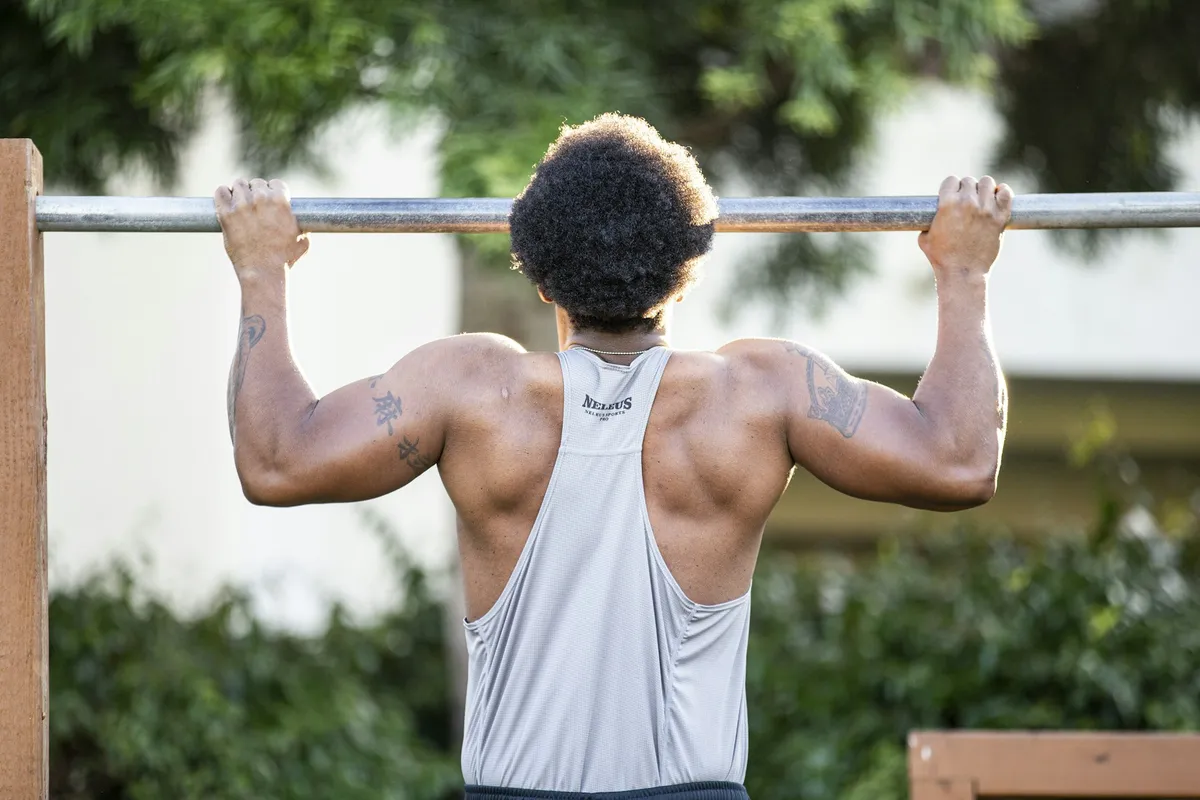
A first pull-up is built in rungs: dead hang, scapular pulls, inverted rows, negatives, then band assisted reps, in that order. A strict rep counts only when your arms start fully straight and your chin clears the bar without a kick or a swing.
 Say where you stand. RepMaxxing sets the target. coming soon
 What are the rungs to a first pull-up?
The rungs to a first pull-up are 5 exercises that each prepare the next, from hanging still to pulling your whole body weight. Every rung uses the same bar and the same grip, so nothing you learn on one has to be unlearned on the next.
- Dead hang. Hang from the bar with straight arms and your shoulders pulled down away from your ears. Work toward holds of 20 to 30 seconds (a rule of thumb, not a finding). This builds grip and gets your shoulders used to carrying your body weight before any pulling happens.
- Scapular pulls. From that same hang, pull your shoulder blades down and together without bending your elbows. The range of motion is a few centimetres, and it teaches the shoulder engagement a pull-up starts with. The full form guide is in scapular pull-ups for beginners.
- Inverted rows. Lie under a bar or a sturdy table and pull your chest toward it while your feet stay on the floor. Your legs carry part of your weight, so this is the first rung where you actually pull. The setup and the ways to make it harder are in inverted rows for pull-ups.
- Negatives. Jump or step to the top position, chin over the bar, then lower yourself as slowly as you can. This rung teaches the exact movement of a pull-up from the top down. The tempo and set scheme are in negative pull-ups for beginners.
- Band assisted reps. Loop a band around the bar and under a foot or knee so it carries part of your weight through the whole rep, up and down. Which thickness to buy is in resistance bands for pull-ups.
The order matters more than the pace. Skipping from dead hangs straight to negatives usually means the shoulder blade control from rungs 2 and 3 never gets built, and the negatives end up as fast drops.
Why do inverted rows count as a real pulling exercise?
Inverted rows count as a real pulling exercise because they work the same muscles a pull-up does, only with your feet taking part of the load. Youdas et al. (2016) measured 9 muscles during 4 inverted row variations and found that biceps, lats, lower trapezius and rear deltoid all exceeded 61 percent of a maximal contraction in every variation. Those are the 4 muscles that do the pulling in a pull-up.
The same study found no difference in muscle activation between rowing with both feet on the floor and rowing with one leg lifted, so there is no need to make the row harder that way. Make it harder by lowering the bar or moving your feet further forward, until you are nearly horizontal. Train sets of 6 to 10 reps (rule of thumb), and move on when 10 clean reps at near horizontal feel controlled.
What counts as a strict pull-up?
A strict pull-up starts from a full dead hang with straight arms and ends with your chin above the bar, with nothing in between borrowed from your hips or legs. A kip, a leg swing or a bounce out of the bottom disqualifies the rep. Then you lower back to a full dead hang under control rather than dropping.
This standard is not pedantry. Dinunzio et al. (2019) compared strict pull-ups with kipping pull-ups in 11 athletes and found the kip raised rectus abdominis activation by 28.7 percent and hip flexor activation by 26.1 percent, while biceps activation dropped by 26.7 percent. The kip moves the work away from the muscles you are trying to build. A kipped rep tells you that your hips can swing, and nothing about whether your arms and back can pull.
Does grip width or hand position matter?
Grip width and hand position change which muscles carry more of the work, and none of the common grips is wrong. Youdas et al. (2010) recorded the lats working at 117 to 130 percent of their maximal isometric contraction in both the pull-up and the chin-up, which is why the pull-up is a back exercise before it is an arm exercise. The chin-up recruited significantly more biceps and chest, the pull-up significantly more lower trapezius.
| Grip | What the evidence says | Source |
|---|---|---|
| Overhand, shoulder width (pull-up) | More lower trapezius than the chin-up; more middle trapezius than a neutral grip | Youdas et al. 2010; Dickie et al. 2017 |
| Underhand (chin-up) | Significantly more biceps and chest than the pull-up; easier for most beginners | Youdas et al. 2010 |
| Neutral grip (palms facing) | Similar overall activation to the other grips; less middle trapezius than overhand | Dickie et al. 2017 |
| Wide overhand | Relatively more lat involvement; a harder rep | Urbanczyk et al. 2020 |
| Underhand, reverse | Higher proportional rotator cuff load | Urbanczyk et al. 2020 |
Dickie et al. (2017) tested overhand, underhand, neutral and rope grips in 19 trained men and found the muscles of the shoulder, arm and forearm activated to a similar degree across a full rep in all of them, with the overhand grip producing 60.1 percent middle trapezius activation against 37.1 percent for the neutral grip. Urbanczyk et al. (2020) modelled shoulder forces in 11 men and found the wide grip loaded the lats most and the reverse grip put the largest share of the load on the rotator cuff. For a first pull-up, use a shoulder width grip, overhand or underhand, whichever your wrists tolerate, and keep every other part of the standard fixed. The full comparison of the 2 grips is in chin-ups vs pull-ups.
How long does each rung take?
There is no fixed number of weeks per rung, and anyone who gives you one is guessing. What is consistent is the trigger for moving on: every rep of every set on the current rung is controlled, with no speeding up on the last rep and no shrug at the top. Move when that is true, not on a calendar.
Two things are settled. The eccentric rung works: Bai et al. (2025) pooled eccentric only upper limb programmes and found a meaningful strength effect (effect size 0.70) from 4 to 8 weeks of training. And nothing is gained by training the rungs daily. The 2 or 3 sessions a week in the beginner calisthenics workout plan leave the rest days that strength gains need; that frequency is a rule of thumb from coaching practice, not a finding from these studies.
What should the first attempt look like?
The first attempt is one strict rep from a full dead hang, taken when band assisted reps on the lightest band feel solid, with the band removed and a camera running. Filming settles the argument your memory will lose about whether the chin actually cleared the bar. If the rep fails halfway, that is information: go back to negatives and band reps for another block and try again at the end of it. When the strict rep is routine and 8 to 10 of them are controlled, the load goes on: that is weighted pull-ups.
When I built RepMaxxing I made one decision about this moment: the app takes your rep counts for pull-up, push-up and dip, never a hang time, because a hang time says nothing about whether you can pull. A goal workout is 6 sessions that end in 1 attempt at a target computed from the numbers you entered, and that target does not move once the goal starts. The first goal workout, Foundation, is free; the weekly bodyweight workouts run Monday to Friday, and filming a set is optional. For what to train before a pull-up is even the goal, see how to start calisthenics.
Questions people actually ask
How long does it take to get a first pull-up?
There is no fixed number of weeks, and any article that gives you one is guessing. What decides it is your starting point and whether you train the rungs 2 or 3 times a week without skipping one. Move to the next rung when every rep of every set of the current one is controlled, and the first strict rep arrives when the band comes off.
What counts as a strict pull-up?
A strict pull-up starts from a full dead hang with straight arms, pulls with no kip or leg swing until the chin clears the bar, then lowers under control back to a full dead hang. If any of those pieces is missing, the rep does not count.
Do I need a resistance band to learn pull-ups?
No. A band is one bridge among several, useful because it lets you practise the full rep pattern with less of your body weight. Negatives and inverted rows build pulling strength without one, so use a band if you have one, not because it is required.
Is a chin-up easier than a pull-up?
For most people, yes. Youdas et al. (2010) measured significantly higher biceps and chest activation in the chin-up than in the pull-up, so the underhand grip brings more muscle to the pull. The rungs to get there are the same either way, so pick the grip your wrists and shoulders tolerate.
Why can't I do a pull-up even though I train?
The usual reason is a skipped rung. Jumping from dead hangs straight to negatives leaves the shoulder blade control from scapular pulls and inverted rows unbuilt, so the negatives turn into fast drops that train nothing. Go back one rung and stay there until every rep is controlled.
Are kipping pull-ups a good way to get my first pull-up?
No. Dinunzio et al. (2019) found the kipping version lowered biceps activation by 26.7 percent and shifted the work to the hips and core. If the goal is a strict pull-up, the kip trains the wrong muscles for it.
References
- Surface electromyographic activation patterns and elbow joint motion during a pull-up, chin-up, or Perfect-Pullup rotational exercise (Youdas et al., J Strength Cond Res, 2010)
- Activation of spinal stabilizers and shoulder complex muscles during an inverted row using a portable pull-up device and body weight resistance (Youdas et al., J Strength Cond Res, 2016)
- Electromyographic analysis of muscle activation during pull-up variations (Dickie et al., J Electromyogr Kinesiol, 2017)
- Alterations in kinematics and muscle activation patterns with the addition of a kipping action during a pull-up activity (Dinunzio et al., Sports Biomech, 2019)
- Avoiding high-risk rotator cuff loading: muscle force during three pull-up techniques (Urbanczyk et al., Scand J Med Sci Sports, 2020)
- Effect of eccentric training with different durations, intensities, and contraction velocities on upper limb muscle strength: a meta-analysis (Bai et al., Life, 2025)