blog
How to Do Push-Ups for Beginners
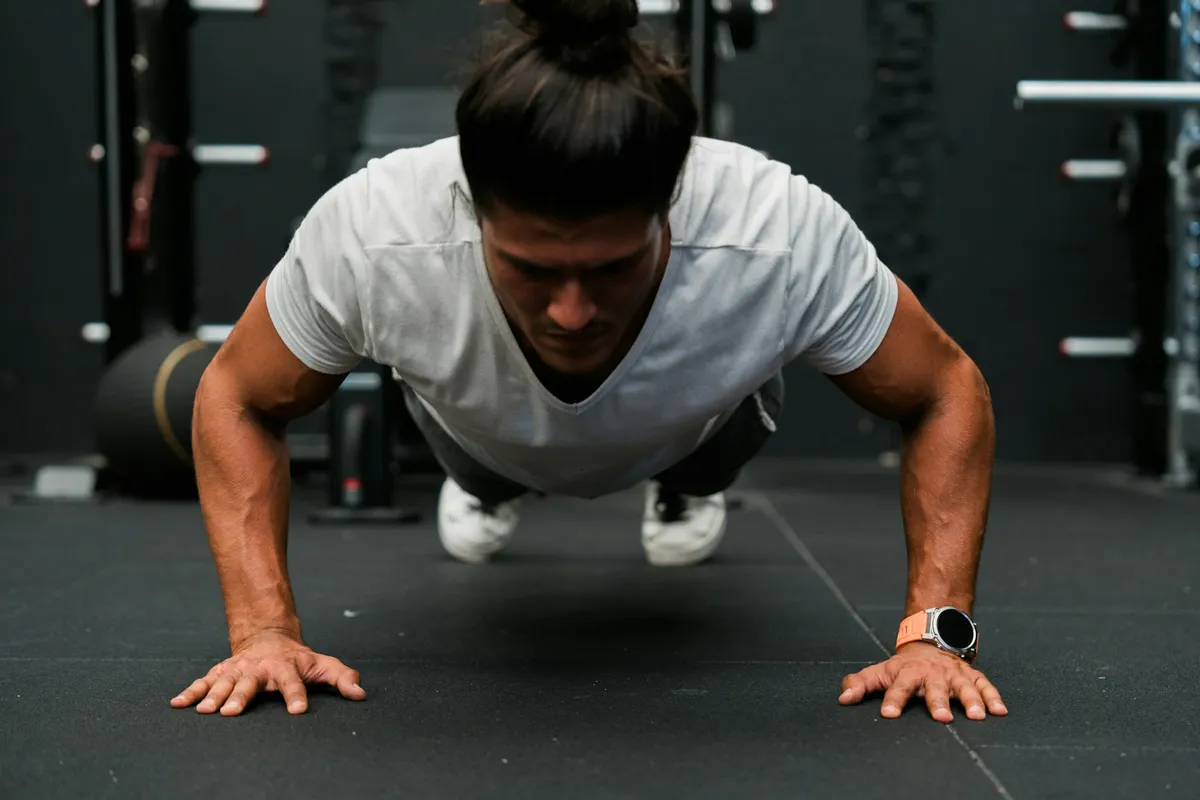
Start against a wall, move to an incline, then to your knees, then to the floor: same body line each time, chest close to the surface, elbows locking out at the top. The variant changes the load on your arms, from a small fraction of your body weight to about two thirds of it. The standard for a clean rep does not change.
 Say where you stand. RepMaxxing sets the target. coming soon
 What does a full push-up look like?
A full push-up is a straight body, lowered and raised by the arms, with the chest coming close to whatever surface you are working against. Hands sit roughly shoulder width apart, fingers pointing forward. Elbows travel back at about 45 degrees from the body rather than flaring straight out to the sides. The line from head to heels stays fixed the whole time: no sagging hips, no piked backside. At the top, the elbows lock out.
That standard does not change between a wall push-up, an incline push-up, a knee push-up and a floor push-up. What changes is how much of your body weight the arms have to move, and that is the entire logic of starting somewhere other than the floor.
What muscles does a push-up work?
A push-up works the chest, the triceps and the serratus anterior, with the shoulders doing far less than people assume. Youdas et al. (2010) measured 4 muscles in 20 people and recorded the chest at 95 to 105 percent of a maximal isometric contraction, the triceps at 73 to 109 percent and the serratus anterior, the muscle that holds the shoulder blade flat against the ribs, at 67 to 87 percent. The rear deltoid worked at 11 to 21 percent.
Hand position shifts the balance. Cogley et al. (2005) compared shoulder width, wide and narrow hand positions in 40 people and found greater chest and triceps activation with the narrow base than the wide one. If your hands sit far outside your shoulders and your elbows flare wide, you are asking the shoulder joint to do work meant for the chest and arms. Shoulder width, or a little narrower, is the beginner’s setting.
How much of your body weight does each variant lift?
Each variant lifts a different fraction of your body weight, and that fraction is what you are choosing when you choose a variant. Gouvali and Boudolos (2005) put 8 men on a force plate and measured the load on the arms at 66.4 percent of body weight in a normal push-up and 52.9 percent on the knees. Ebben et al. (2011) tested 6 variations in 23 people and found that raising the hands on a box, at 30 or 60 centimetres, and dropping to the knees both loaded the arms less than every other version, while raising the feet loaded them more.
| Variant | Load on the arms | Source |
|---|---|---|
| Wall push-up | Lowest; not measured in these studies | leverage |
| Hands on a 60 cm box | Lower than a floor push-up | Ebben et al. 2011 |
| Hands on a 30 cm box | Lower than a floor push-up | Ebben et al. 2011 |
| Knee push-up | About 53 percent of body weight | Gouvali and Boudolos 2005 |
| Floor push-up | About 66 percent of body weight | Gouvali and Boudolos 2005 |
| Feet raised on a box | Higher than a floor push-up | Ebben et al. 2011 |
One more thing the force plate shows: the load is not constant through the rep. Suprak et al. (2011) measured 28 trained men in the top and bottom positions and found the arms carry less weight at the top than at the bottom, in both the floor and the knee version. The bottom of the rep is the hardest part for a reason, and it is the part beginners cut short.
What are the steps from the wall to the floor?
The steps from the wall to the floor are 4 variants, each one carrying more of your weight than the last. Move to the next when a set of 10 to 15 on the current one keeps the full standard, which is a rule of thumb; the calendar is not the signal.
- Wall push-up. Stand an arm’s length from a wall, hands on it at shoulder height and width, body in one line from head to heels. Bend the elbows until your chest nears the wall, press back to lockout. Almost none of your body weight loads the arms. Most people leave this stage within a few sessions. The full guide is in wall push-ups for beginners.
- Incline push-up. Hands on a counter, then a table, then a bench, feet on the floor. Every step down puts more weight on the arms, and there are many steps available. The guide is in incline push-ups for beginners.
- Knee push-up. Hands on the floor at shoulder width, knees down, the straight line running from knees to head. About 53 percent of your body weight is on the arms. Gottschall et al. (2018) measured 8 muscles in 12 men and found no difference between toes and knees in how much each main muscle contributed, and concluded that knee push-ups are an ideal novice variation.
- Floor push-up. Feet down, about 66 percent of your body weight on the arms, full range, chest close to the ground, elbows locked at the top.
Incline and knee push-ups are not in a fixed order. A low incline is harder than a knee push-up; a high one is easier. Use whichever step is available where you train.
How do you know a push-up counts?
A push-up counts when it passes 3 checks in order, and a phone propped against a wall is the only reliable judge of all 3.
- The line. Shoulders, hips and knees, or heels, stay level from the top of the rep to the bottom. A sag at the hips is the first thing to go when a set gets hard.
- The depth. The chest comes close to the floor, wall or surface on every rep, not halfway. This is where the load is highest, so it is where reps get shortened.
- The lockout. The elbows straighten fully at the top before the next rep starts.
Filmed reps settle arguments that memory loses. Reps that only look clean from the inside are the most common reason a beginner’s count stalls: the number goes up while the rep gets shorter.
How often should a beginner train push-ups?
A beginner should train push-ups 2 or 3 times a week, with a rest day between sessions. The evidence for more than 1 session a week is solid: Grgic et al. (2018) pooled 22 studies and found strength gains grew with frequency, with effect sizes of 0.74, 0.82, 0.93 and 1.08 for 1, 2, 3 and 4 or more sessions a week, and the frequency effect was significant for upper body strength in particular. The same analysis found no frequency effect once weekly volume was equated, so what matters most is the total work you do in the week. Two or 3 sessions is the rule of thumb that gets that work done with rest between.
Sets and reps depend on the variant. Stop each set 2 or 3 reps before the form breaks (rule of thumb); the lockout and the line are the signal, not a number. How to pick a first target from where you stand today is the whole subject of how many push-ups a beginner should aim for, and the week that holds the sessions is in the beginner calisthenics workout plan.
I built RepMaxxing around the number at the end of this process rather than the variant: you enter your current push-up count, 0 included, and a goal workout is 6 sessions ending in 1 attempt at a target computed from that number and held fixed until you reach it. The app takes rep counts for push-up, pull-up and dip, and the first goal workout, Foundation, is free.
Questions people actually ask
Do wall push-ups actually count as training?
Yes, for a true beginner. They teach the pressing pattern and elbow path with almost no load, so the movement is correct before any weight is added. They stop being useful once you can do a set of 10 to 15 with a straight body line, which for most people takes days, not months.
How long should I stay on knee push-ups before trying the floor?
Form is the test, not the calendar. Move to the floor when a set of 10 knee push-ups keeps a straight line from knees to head with the chest close to the floor on every rep. Two or 3 weeks is common, and that number is a rule of thumb.
Is it cheating to keep my knees down?
No. Gouvali et al. (2005) measured the load on the arms at 66.4 percent of body weight in a floor push-up and 52.9 percent on the knees, and Gottschall et al. (2018) found the main muscles contribute in the same proportions on toes and on knees. A knee push-up is the same exercise with less resistance.
What muscles do push-ups work?
Chest, triceps and serratus anterior, the muscle that holds the shoulder blade against the ribs. Youdas et al. (2010) measured the chest at 95 to 105 percent and the triceps at 73 to 109 percent of a maximal contraction during a push-up. The rear shoulder works little, at 11 to 21 percent.
Should my hands be wide or narrow for push-ups?
Shoulder width or a little narrower. Cogley et al. (2005) measured more chest and triceps activation with a narrow hand position than a wide one in 40 people. A wide base with flared elbows moves work from the chest and arms onto the shoulder joint.
How many push-ups should a beginner do per set?
Sets that stop 2 or 3 reps before your form breaks, 3 to 4 sets, 2 or 3 times a week, as a rule of thumb. What number that gives depends on your variant. Picking a first target is covered in how many push-ups a beginner should aim for.
References
- Dynamic and electromyographical analysis in variants of push-up exercise (Gouvali and Boudolos, J Strength Cond Res, 2005)
- Comparison of muscle activation using various hand positions during the push-up exercise (Cogley et al., J Strength Cond Res, 2005)
- Comparison of muscle-activation patterns during the conventional push-up and Perfect Pushup exercises (Youdas et al., J Strength Cond Res, 2010)
- Muscle activity patterns do not differ between push-up and bench press exercises (Gottschall et al., J Appl Biomech, 2018)
- Kinetic analysis of several variations of push-ups (Ebben et al., J Strength Cond Res, 2011)
- The effect of position on the percentage of body mass supported during traditional and modified push-up variants (Suprak et al., J Strength Cond Res, 2011)