blog
Incline Push-Ups for Beginners
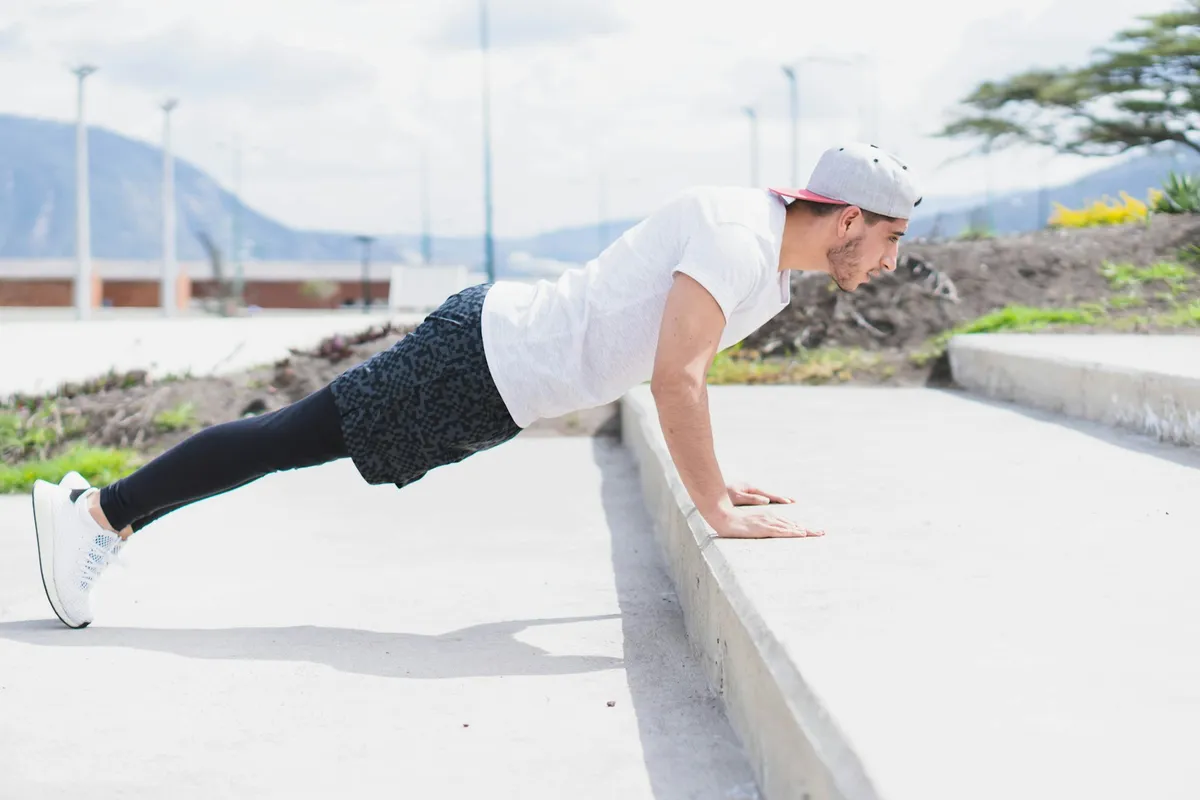
An incline push-up is a normal push-up with your hands raised on a stable surface, which cuts how much of your body weight your arms have to lift. Lower the surface a step each time a set gets easy, until your hands reach the floor and the arms carry about two thirds of your weight.
 Say where you stand. RepMaxxing sets the target. coming soon
 What is an incline push-up?
An incline push-up is a push-up with the hands on a raised surface and the feet on the floor, so the body works at an angle and the arms lift less of it. Everything else stays the same: a straight line from head to heels, the chest moving toward the surface, the elbows locking out at the top. The only variable is height.
A kitchen counter is an easy incline. A step or a low bench is a hard one. Between those two is a ramp with as many steps as you have surfaces, which is the main reason incline push-ups are more useful to a beginner than knee push-ups alone: a bench has more heights than your knees do. The incline sits between the wall and the floor in how to do push-ups for beginners.
Why does raising your hands make a push-up easier?
Raising your hands makes a push-up easier because it moves your centre of mass toward your feet, so the arms hold a smaller share of your body weight. Gouvali and Boudolos (2005) measured that share on a force plate at 66.4 percent of body weight for a floor push-up and 52.9 percent on the knees. Ebben et al. (2011) put 23 people through 6 variations and found that hands raised on a 30 or a 60 centimetre box loaded the arms less than every other variation apart from the knee version, while feet raised on a box loaded them more.
| Variant | Load on the arms | Source |
|---|---|---|
| Wall push-up | Lowest; not measured | leverage |
| Hands on a 60 cm box | Lower than the floor version | Ebben et al. 2011 |
| Hands on a 30 cm box | Lower than the floor version | Ebben et al. 2011 |
| Knee push-up | 52.9 percent of body weight | Gouvali and Boudolos 2005 |
| Floor push-up | 66.4 percent of body weight | Gouvali and Boudolos 2005 |
| Feet on a box | Higher than the floor version | Ebben et al. 2011 |
The load is also not constant within a rep. Suprak et al. (2011) measured 28 trained men at the top and bottom of the push-up and found the arms carry less at the top than at the bottom. On an incline the bottom position is where your chest meets the edge of the surface, and it is the position beginners shorten first.
How do you set up an incline push-up?
An incline push-up is set up in 4 steps, and the second one is where most people get it wrong.
- Hands. On the raised surface at shoulder width, fingers pointing forward, palms flat, on something that does not move. Pirauá et al. (2014) measured 30 men doing push-ups on stable and unstable surfaces and found the unstable one cut serratus anterior activity and raised trapezius activity. A wobbling surface trains balance, not pressing.
- Feet. Walk them back until your body is one straight line from head to heels. Standing too close to the surface shortens the range and lets the hips do work the arms should do. Feet further back means more of your weight in the bottom position, which is the resistance you are training for.
- Lower. Chest toward the edge of the surface, elbows travelling back at about 45 degrees rather than flaring out. Touch, or come within a few centimetres.
- Press. Back to a full elbow lockout, with the line unchanged.
Shoulders stay down, away from the ears, for the whole set. That is the job trained on its own in scapular push-ups.
How do you choose the height and how many reps?
Choose the height that lets you do 8 to 12 reps with the same form you would want on the floor: straight line, full range, controlled tempo. That rep range is the American College of Sports Medicine’s recommendation for novices in its position stand on progression, which advises loads corresponding to an 8 to 12 repetition maximum and 2 or 3 sessions a week; an incline is how you choose that load without weights. 3 sets, 2 or 3 times a week, is the rule of thumb that fits it.
If your best set is 2 or 3 shaky reps, the surface is too low; raise it. If the last rep of a set looks identical to the first, the surface is too high for training gains and it is time to lower it.
When and how do you lower the incline?
Lower the incline when every rep of every set at the current height keeps the standard, and move down in small steps rather than large ones. A kitchen counter to a dining table is a big jump for someone new to the movement; a table to a low bench is a more even one. Track the surface you used and the reps you got, since that record is what tells you whether the last change was too big to hold your form.
Progression is the whole point, and it works. Kotarsky et al. (2018) trained 14 men with progressive push-up variations 3 days a week for 4 weeks and found their bench press 1 repetition maximum rose significantly, matching a group of 9 who trained with the barbell, and their push-up progression score rose more. A push-up that keeps getting harder builds strength like a barbell does. A push-up that stays at the same height for months does not.
Where does the incline lead?
The incline leads to the floor: keep lowering the surface and the incline push-up becomes a floor push-up, at which point height disappears as a variable and reps become the only thing left to progress. How to pick the first rep target is in how many push-ups a beginner should aim for, and the days that hold the sets are in the beginner calisthenics workout plan.
When I built RepMaxxing I made the push-up count the input, not the variant: you enter the number you can do today, incline or floor, and a goal workout is 6 sessions ending in 1 attempt at a target computed from that number and held fixed until you reach it. The first goal workout, Foundation, is free.
Questions people actually ask
What surface should I use for incline push-ups?
Anything sturdy that will not slide: a kitchen counter, a table, a bench, a step, a loaded barbell rack. Avoid anything that rocks. Pirauá et al. (2014) found an unstable surface lowered serratus anterior activity and raised trapezius activity, which turns a strength drill into a balance drill.
Are incline push-ups easier than knee push-ups?
It depends on the height. Gouvali and Boudolos (2005) put a knee push-up at 52.9 percent of body weight; a high incline like a counter is easier than that, a low step is closer to it or harder. Height is the dial. Use whichever step you have.
How much of my body weight is an incline push-up?
Less than the 66.4 percent of a floor push-up, and less the higher the surface. Ebben et al. (2011) measured hands raised on 30 and 60 centimetre boxes and found both loaded the arms less than every other variation apart from the knee version. The exact fraction depends on your height and the box.
How many incline push-ups should I do?
3 sets of 8 to 12 at a height where the last rep is still clean, 2 or 3 times a week, as a rule of thumb. The ACSM position stand for novices recommends loads that allow 8 to 12 repetitions; an incline is how you choose that load without weights.
How do I know when to lower the incline?
When every rep of every set at the current height keeps the straight line, the full range and the lockout, drop to the next lower surface you have. If the new height only gives you 2 or 3 shaky reps, the step was too big; go back up.
Do incline push-ups build muscle?
Yes, when they are hard enough. Kotarsky et al. (2018) trained men with progressive push-up variations 3 days a week for 4 weeks and found bench press strength rose significantly, the same as a group training with the barbell. The incline is the progression; the load has to keep rising.
References
- Kinetic analysis of several variations of push-ups (Ebben et al., J Strength Cond Res, 2011)
- Dynamic and electromyographical analysis in variants of push-up exercise (Gouvali and Boudolos, J Strength Cond Res, 2005)
- The effect of position on the percentage of body mass supported during traditional and modified push-up variants (Suprak et al., J Strength Cond Res, 2011)
- Effect of progressive calisthenic push-up training on muscle strength and thickness (Kotarsky et al., J Strength Cond Res, 2018)
- Electromyographic analysis of the serratus anterior and trapezius muscles during push-ups on stable and unstable bases (Pirauá et al., J Electromyogr Kinesiol, 2014)
- American College of Sports Medicine position stand: progression models in resistance training for healthy adults (Med Sci Sports Exerc, 2009)