blog
Scapular Push-Ups for Beginners
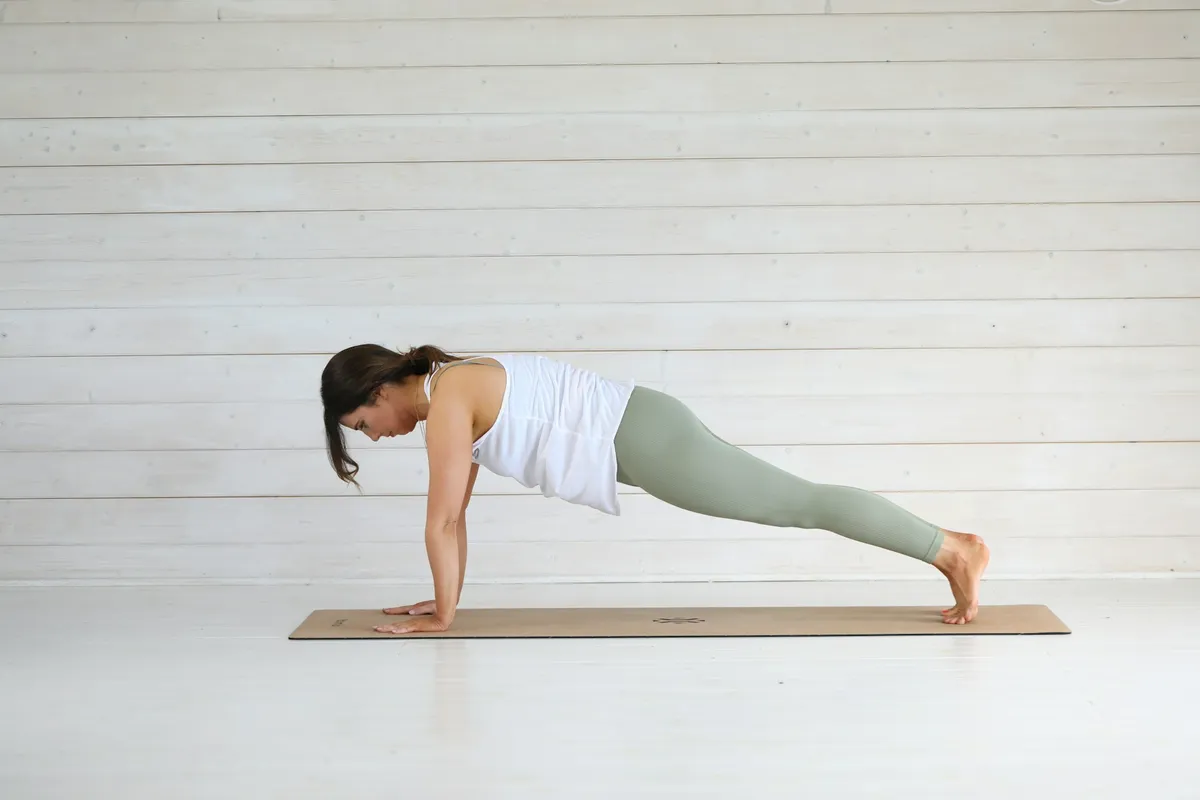
A scapular push-up, also called a scapula push-up or a push-up plus, holds a plank with straight arms and moves only the shoulder blades, protracting them apart and retracting them together. It builds the shoulder stability every push-up variation needs before the elbow bends at all, and 2 or 3 sets of 8 to 12 reps is enough.
 Say where you stand. RepMaxxing sets the target. coming soon
 What is a scapular push-up?
A scapular push-up is the top of a push-up position held with straight arms while only the shoulder blades move. From a plank on your hands and toes, or your knees if that is your current push-up level, let your chest sink slightly as your shoulder blades pull together and down, then press the floor away so your shoulder blades spread apart and your upper back rounds a little. The elbows never bend. The whole rep happens at the shoulder blade.
Physiotherapists call the same drill a push-up plus, where the plus is the extra press at the top that spreads the blades. It is the shoulder blade half of every push-up in how to do push-ups for beginners, isolated so it can be trained on its own.
Why do the shoulder blades matter in a push-up?
The shoulder blades matter because a push-up needs them to move freely along the rib cage before the elbow does any real work, and the muscle that does that job is one a push-up trains hard. Youdas et al. (2010) measured the serratus anterior, the muscle that pulls the shoulder blade forward and holds it flat against the ribs, at 67 to 87 percent of a maximal contraction during an ordinary push-up in 20 people. When the blade stays fixed instead, the shoulder joint absorbs load it was not built to carry, and that shows up as elbows flaring out or the chest never settling into the bottom of the rep.
The scapular push-up trains that muscle harder than the push-up itself. Ludewig et al. (2004) compared push-up plus variations in 30 people, healthy and with mild shoulder dysfunction, and found the standard push-up plus produced the highest serratus anterior activation of every variation, up to 123 percent of a maximal contraction, with the lowest ratio of upper trapezius to serratus, under 0.2. That ratio is the point: the drill works the muscle that stabilises the blade without recruiting the shrugging muscle above it.
How do you do a scapular push-up correctly?
A correct scapular push-up has 4 parts, and the elbows stay locked through all of them.
- Set the plank. Hands under the shoulders, body in one straight line from head to heels, or from head to knees in the knee version. Lock the elbows.
- Let the blades pull together. Your chest drops 2 to 5 centimetres as the shoulder blades squeeze toward the spine. Pause for 1 to 2 seconds.
- Press the floor away. Push until your upper back rounds and the shoulder blades spread as far apart as they will go. This is the plus. Pause again.
- Repeat. Slowly. The 2 pauses do more for the drill than speed ever will, because the point is control, not a burn.
The most common breakdown is the elbows bending to finish a rep. If you catch yourself bending them, the range you are asking for is too big; shrink it and keep the elbows straight.
| Phase | Shoulder blade movement | Muscle doing most of the work | Evidence |
|---|---|---|---|
| Pulling together, chest sinks | Retraction, blades squeeze toward the spine | Trapezius, middle and lower | Ludewig et al. 2004 |
| Pushing apart, upper back rounds | Protraction, blades spread away from the spine | Serratus anterior, up to 123 percent MVIC | Ludewig et al. 2004 |
Does the knee version work as well?
The knee version works as well for the muscle that matters. Horsak et al. (2017) measured 19 women doing the knee push-up plus and an isolated kneeling protraction on 3 surfaces and found serratus anterior activity did not differ between the exercises or the surfaces, with only slightly more upper and lower trapezius in the full knee push-up plus. Their conclusion was that the kneeling protraction is enough to activate the serratus selectively, and they recommended it for people who cannot yet perform a whole push-up.
So the knee version is the right one for anyone still at wall push-ups or a high incline. The shoulder blades learn the same movement with less weight on the wrists.
How many sets and reps?
2 or 3 sets of 8 to 12 reps, 2 or 3 times a week, done before your regular push-up sets rather than instead of them. Every number in that sentence is a rule of thumb for a drill whose purpose is position rather than fatigue. Treat it as preparation for the push-up, not a substitute for it.
Do it on the floor. Pirauá et al. (2014) measured 30 men on stable and unstable surfaces and found the unstable one decreased serratus anterior activity and increased trapezius activity, the opposite of what the drill is for. Kang et al. (2019) pooled 19 studies with 356 participants and found upper trapezius activity rose by 2.74 percent on unstable surfaces. A stability ball turns a serratus drill into a shrug.
Where does it sit under every push-up?
It sits under every push-up: wall, incline, knee or floor, each asks the shoulder blade to do this same job underneath whatever the elbows are doing. Add a set or 2 ahead of your push-up sets on the training days of the beginner calisthenics workout plan, and keep it as a warm-up long after the floor push-up is routine. The pulling counterpart, the same idea at the bar, is the scapular pull-up.
Scapular push-ups are not one of the 3 movements I built RepMaxxing to count. The app takes rep counts for push-up, pull-up and dip, and a goal workout is 6 sessions ending in 1 attempt at a target computed from those numbers and held fixed. Scapular push-ups are what you do in the first minutes of those sessions so the push-up count that follows is built on a shoulder that knows its job. The first goal workout, Foundation, is free.
Questions people actually ask
Is a scapular push-up the same as a push-up plus?
Yes. Push-up plus is the name used in physiotherapy research; scapular push-up and scapula push-up are the names used in general fitness. All 3 describe the same straight arm protraction and retraction from a plank, and the plus is the protraction at the top.
What muscles do scapular push-ups work?
The serratus anterior in the pushing apart phase and the trapezius in the pulling together phase. Ludewig et al. (2004) measured serratus anterior activation up to 123 percent of a maximal contraction during the plus phase of a standard push-up plus, the highest of every variation they tested.
Do scapular push-ups build muscle or just teach positioning?
Both. A serratus anterior working at over 100 percent of a maximal isometric contraction, as Ludewig et al. (2004) measured, is a training stimulus, not a warm-up. What they do not build is the pressing strength of the chest and triceps, which is why they go alongside push-ups and not instead of them.
Can I do scapular push-ups on my knees?
Yes, and it works. Horsak et al. (2017) measured 19 women doing the knee push-up plus and found serratus anterior activity as high as in the isolated protraction, independent of the surface. Knees down is the right version for anyone who cannot yet hold a plank for a set.
How many scapular push-ups should I do?
2 or 3 sets of 8 to 12 reps, 2 or 3 times a week, with a 1 to 2 second pause at each end of the rep, done before your push-up sets, as a rule of thumb. Speed defeats the drill; the pause is the exercise.
Should I do scapular push-ups on a stability ball or a wobble board?
No. Pirauá et al. (2014) found an unstable surface cut serratus anterior activity and raised trapezius activity, and Kang et al. (2019) pooled 19 studies and found upper trapezius activity rose by 2.74 percent on unstable surfaces. The floor is the right surface for this drill.
References
- Relative balance of serratus anterior and upper trapezius muscle activity during push-up exercises (Ludewig et al., Am J Sports Med, 2004)
- Serratus anterior and upper trapezius electromyographic analysis of the push-up plus exercise: a systematic review and meta-analysis (Kang et al., J Athl Train, 2019)
- Serratus anterior and trapezius muscle activity during knee push-up plus and knee-plus exercises performed on a stable, an unstable surface and during sling-suspension (Horsak et al., Phys Ther Sport, 2017)
- Electromyographic analysis of the serratus anterior and trapezius muscles during push-ups on stable and unstable bases in subjects with scapular dyskinesis (Pirauá et al., J Electromyogr Kinesiol, 2014)
- Comparison of muscle-activation patterns during the conventional push-up and Perfect Pushup exercises (Youdas et al., J Strength Cond Res, 2010)