blog
Scapular Pull-Ups for Beginners
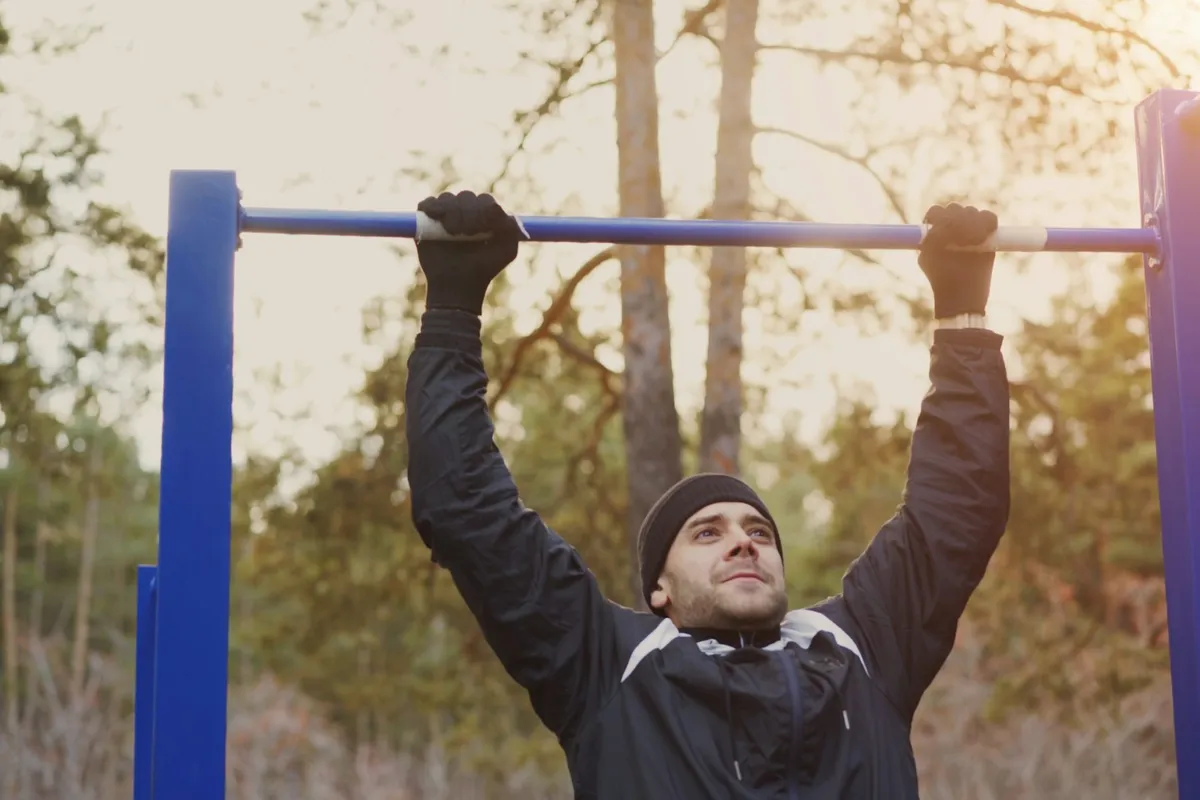
A scapular pull-up, also called a scapular pull, hangs from the bar with straight arms and pulls only the shoulder blades down and together, with no bend at the elbow. It is the first rung under a full pull-up, building the shoulder engagement a real rep needs before any pulling strength is asked of the arms.
 Say where you stand. RepMaxxing sets the target. coming soon
 What is a scapular pull-up?
A scapular pull-up is a dead hang in which only the shoulder blades move: you hang from the bar with straight arms and pull the blades down and together, so your body rises 2 or 3 centimetres, then you let them ride back up under control. The elbows never bend. The range of motion is small on purpose, because the point is teaching the shoulder to engage before the elbow gets involved, not moving your chin toward the bar.
It is the second rung under a real pull-up, after the dead hang and before the inverted row, in the order laid out in how to do your first pull-up.
Why train the shoulder blades before the elbows?
The shoulder blades come first because a pull-up starts there. Youdas et al. (2010) tracked the timing of muscle activation across the pull-up cycle in 25 people and found a sequential pattern: the rep was initiated by the lower trapezius and the chest, and completed by the biceps. The lower trapezius is the muscle that pulls the shoulder blade down, and it worked at 45 to 56 percent of a maximal contraction across the whole rep. A scapular pull-up trains that first movement on its own.
Skip it and the shoulder joint takes load it is not positioned to handle. Prinold and Bull (2016) measured scapular kinematics in 11 regular pull-up trainees and reported that high arm elevation during pull-ups reduces the sub-acromial space and raises the pressure there, which is the mechanism of impingement. A shoulder blade that is set down before the pull keeps the joint out of that position. This is the same reason physiotherapists choose exercises for the shoulder that favour the lower and middle trapezius over the upper: Cools et al. (2007) tested 12 scapular exercises in 45 people and recommended the ones with high lower trapezius activation and low upper trapezius activation for restoring muscle balance.
How do you do a scapular pull-up correctly?
A correct scapular pull-up has 4 parts, and the elbows stay straight through all of them.
- Grip. Hold the bar slightly wider than shoulder width, overhand, and hang with straight arms.
- Relax first. Let the shoulders ride up toward the ears so you have somewhere to pull them down from. This is the top of the movement.
- Pull the blades down and together. Your body rises a few centimetres. Hold the bottom position for 1 to 2 seconds. Your chest moves slightly toward the bar; your elbows do not bend.
- Return under control. Let the blades ride back up slowly. Do not drop into the relaxed hang.
If your elbows start bending to help, the movement has turned into a partial pull-up, which is a different exercise with a different purpose.
| Rung | Exercise | What it teaches | Guide |
|---|---|---|---|
| 1 | Dead hang | Grip and shoulder tolerance under body weight | this article, step 2 |
| 2 | Scapular pull-up | Shoulder blade engagement before any elbow bend | this article |
| 3 | Inverted row | Pulling with the feet taking part of the load | inverted rows |
| 4 | Negative pull-up | Controlling the full movement from the top down | negative pull-ups |
| 5 | Band assisted pull-up | A complete rep with reduced body weight | resistance bands |
How many sets and reps?
2 to 3 sets of 8 to 10 reps, 2 or 3 times a week, with a 1 to 2 second pause at the bottom of every rep. Those numbers are a rule of thumb for a drill whose purpose is position rather than fatigue; no study prescribes a set scheme for scapular pulls. Speed defeats the exercise. A slow, held rep teaches the position; a fast rep bounces through it.
If a full hang is still hard, rest your toes lightly on a box so your legs carry part of your weight, and do the same movement. The shoulder blades do not care how much weight is on them at first, only that they move in the right direction.
What are the common mistakes?
The most common mistake reverses the whole point of the drill: shrugging the shoulders up toward the ears instead of pulling them down. A shrug is the movement that recruits the upper trapezius most; Ekstrom et al. (2003) measured 10 exercises in 30 people and found the shoulder shrug produced the highest upper trapezius activation of all of them. A scapular pull-up should feel like the opposite of a shrug: down and together, not up and in.
The second mistake is letting the elbows bend to chase a bigger range of motion. Keep the movement small and the elbows locked; the shoulder blade only travels a few centimetres, and that is enough.
The third is rushing. A rep with no pause at the bottom never lets you feel the position you are trying to learn. Time the pause early on until it becomes automatic.
What if you cannot feel your shoulder blades move?
If you cannot feel the shoulder blades move on the bar, take the drill to the floor first. Lie face down with your arms overhead, thumbs up, and lift your arms a few centimetres by pulling the shoulder blades down and together, holding 2 seconds; this is the prone overhead raise that Ekstrom et al. (2003) found produced the highest lower trapezius activation of the 10 exercises they measured. A few sets of 10 (rule of thumb) teach the direction without any body weight on the joint.
Then go back to the bar and hang with your toes on a box so the load is lighter. Ask someone to put a finger on the bottom tip of your shoulder blade; when the pull is right, that tip moves down and toward your spine. Once you can feel it with the toes down, take the box away.
Where does this fit in a beginner plan?
Scapular pull-ups fit on the pull-up days of the beginner calisthenics workout plan, 2 or 3 sets before the row or the negative, and they keep earning a place as a warm-up long after you have your first strict rep. The rung after this one, the inverted row, uses the same muscles at a higher load: Youdas et al. (2016) measured the lower trapezius above 61 percent of a maximal contraction during the inverted row. For what to train before pull-ups are even the goal, see how to start calisthenics.
When I built RepMaxxing I put pull-up, push-up and dip in the app, and scapular pulls are not a movement the app counts. That is deliberate: the app takes the rep count you enter for a pull-up, 0 included, and a goal workout is 6 sessions ending in 1 attempt at a target computed from that number and held fixed. Scapular pulls are how you build a number worth entering. The first goal workout, Foundation, is free.
Questions people actually ask
Is a scapular pull-up the same as a scapular pull?
Yes. Both names describe the same drill: hanging from a bar with straight arms and moving only the shoulder blades down and together, with no bend at the elbow. Some coaches also call it a scap pull or a hanging scapular depression.
Do I need to be able to hang from a bar before scapular pull-ups?
You need to hang long enough to get through a set, which is a lower bar than it sounds. A 10 to 15 second dead hang is usually enough grip and shoulder tolerance for a set of 8 scapular pulls; that number is a rule of thumb.
How many scapular pull-ups should I do?
2 to 3 sets of 8 to 10 reps, 2 or 3 times a week, with a 1 to 2 second pause at the bottom of every rep, as a rule of thumb. Slow reps teach the position; fast reps bounce through it.
How long should I do scapular pull-ups before moving on?
There is no fixed number of weeks. Move to inverted rows once a set of 8 to 10 scapular pulls feels controlled with a clear pause at the bottom and no shrug at the top, not once a calendar says so.
What muscles do scapular pull-ups work?
Mainly the lower trapezius and the lats, the muscles that pull the shoulder blades down, plus the grip. Youdas et al. (2010) measured the lower trapezius at 45 to 56 percent of a maximal contraction during a full pull-up; the scapular pull isolates that part of the rep.
Why do my shoulders shrug up when I hang from the bar?
Because a relaxed hang lets the shoulder blades ride up toward the ears, and the upper trapezius takes over. That is the position a scapular pull-up trains you out of: pull the blades down and together first, then hold it, so the shrug never becomes the start of your pull-up.
References
- Surface electromyographic activation patterns and elbow joint motion during a pull-up, chin-up, or Perfect-Pullup rotational exercise (Youdas et al., J Strength Cond Res, 2010)
- Activation of spinal stabilizers and shoulder complex muscles during an inverted row using a portable pull-up device and body weight resistance (Youdas et al., J Strength Cond Res, 2016)
- Scapula kinematics of pull-up techniques: avoiding impingement risk with training changes (Prinold and Bull, J Sci Med Sport, 2016)
- Rehabilitation of scapular muscle balance: which exercises to prescribe? (Cools et al., Am J Sports Med, 2007)
- Surface electromyographic analysis of exercises for the trapezius and serratus anterior muscles (Ekstrom et al., J Orthop Sports Phys Ther, 2003)